
How can a person live on other objects of the Solar system, including the Moon and Mars
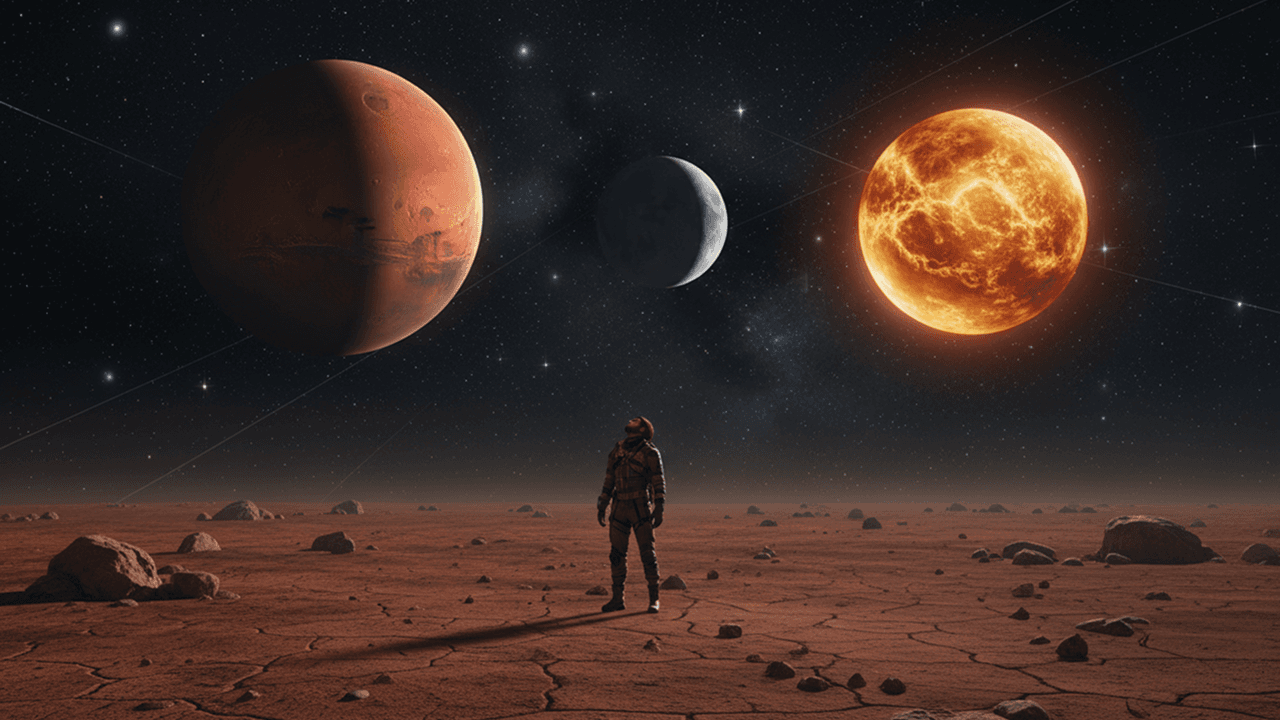
Humanity is entering a new space age. What seemed like fantasy yesterday – building bases on other planets, mining resources in space, and terraforming – is now becoming the subject of strategic planning and specific engineering tasks. We are on the verge of becoming an interplanetary species.
Among all the objects of the Solar System, scientists and engineers identify two of the most realistic directions for the first colonization.
The moon is seen as an ideal "testing ground" for technology development. Due to its proximity to Earth and the availability of resources (for example, water ice in craters), it is possible to create the first permanent base here. There are already projects that propose to place modules for life and research on the satellite, from laboratories to warehouses. In the coming years, NASA, Russia and China are planning new phases of lunar exploration, including manned flights and landings.
Mars, on the contrary, beckons with the prospect of creating a "backup planet" for humanity. Despite the thin atmosphere of carbon dioxide and high levels of radiation, the Red Planet remains the main target. Among the colonization ideas are the construction of underground cities in lava tubes and even terraforming using nuclear explosions, which is proposed by Elon Musk.
The rest of the planets are either too inhospitable or have no solid surface at all.
Venus, despite its similarity to Earth in size, is a real hell: the surface temperature is +460°C, the pressure is 90 times higher than Earth's, and the clouds are composed of sulfuric acid. The only possible way to live here is to create flying airship cities at an altitude of 50 km.
Mercury suffers from colossal temperature fluctuations (from +427°C during the day to -173°C at night). Life here is theoretically possible only at the poles, in the craters of eternal darkness, where there are reserves of ice.
The giant planets (Jupiter, Saturn, Uranus, Neptune) do not have a solid surface and consist of gases, which makes classical colonization impossible.
Today, not only governments and corporations play an important role in space exploration, but also private initiatives and technological competitions. It is contests like the legendary Ansari X Prize (the winner of which SpaceShipOne launched Virgin Galactic), allow you to attract young talents to solve ambitious tasks.
A vivid example of this approach in Russia is the initiative of Ilya Chekhov, the founder of the Motorika company. He opened the Frontiers of Science Scientific and Technical Guild and, together with the Braim platform, launched the Space Cup: Moon Mission competition. The task for young professionals (students, postgraduates and anyone from 16 to 27 years old) is to create a web–based solution for planning the construction of a base at the South Pole. Moon and further management of this base and its resources.
Colonization of other worlds is an inevitable stage of evolution, just like the time when people came from the ocean to land or the era of Great Geographical Discoveries. Mercury with its icy craters, Venus with acid clouds and Mars with lava caves are full of mysteries. But it is the Moon, due to its location, that will become humanity 's first space home and a springboard for jumping to the stars. And it's up to new generations to build this house, who are already being attracted to solving real engineering problems.